

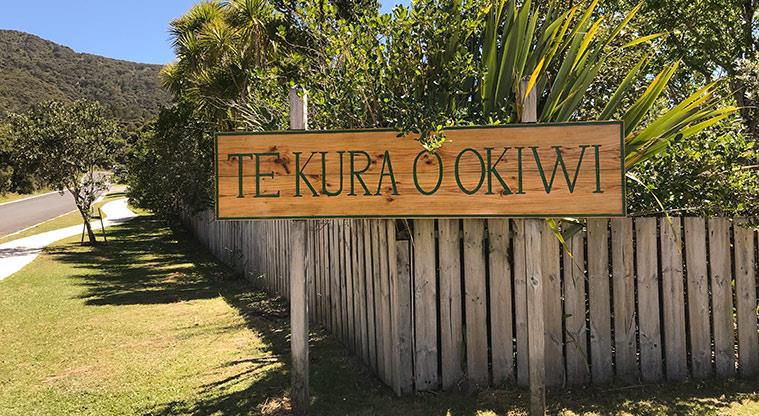

UPDATED: Okiwi School is among dozens of rural New Zealand schools caught in a water safety issue, with new data revealing water harboured “high risk” contaminants.
Official figures show more than 60 schools across the country were forced to rely on bottled water or boil-water notices last year.
Okiwi School, a cornerstone of the North Barrier community, recorded four separate detections of contaminated water in 2025, amongst the highest in the country.
However, the school says the situation has now been fully resolved.

“It is good to highlight the concerns and challenges facing rural schools regarding safe drinking water,” Te Kura o Okiwi said in a statement. “However, we want to make sure it is clear that there is no water risk at Okiwi School.”
The school confirmed that while some — but not all — water sources previously tested positive for E. coli and/or coliforms, a major upgrade has since been completed.
“Thanks to the Ministry of Education, they funded a major water upgrade in 2025, which means ALL our water sources are now safe,” the statement said.

Okiwi added it now conducts monthly testing and reporting, in line with national requirements.
The Fallout
E. coli is a bacterium that signals fecal contamination. Under national standards, the limit for drinking water is zero.

A single positive test means the water is legally unsafe to drink.
For schools like Okiwi, which rely on rainwater tanks and bores rather than a town supply, the burden of managing the risks unfairly fall on overstretched staff, according to the regulator.
‘A Nightmare’
The national regulator, Taumata Arowai, slammed the risks and burdens for administrators as “extremely high.”
In similar rural settings, principals have described the situation as a “nightmare,” with staff forced to buy supermarket water containers just to keep the taps running.
While bore, rain, and stream water collection on the Barrier is a way of life, meeting modern regulatory standards is becoming an increasingly expensive challenge.
Installing a fully compliant, commercial-grade filtration and UV treatment system can cost upwards of $100,000.
Andrew King, president of the New Zealand Rural Schools Leadership Association, says the system is broken.
“The schools don’t have money and they don’t have the knowledge,” King said. “Why should a principal have the knowledge when their speciality is teaching?”
The Ministry’s Promise
The Ministry of Education is now under pressure to “urgently lift its game.”
A new agreement with the regulator aims to have 64 high-priority schools compliant by June this year, but a full fix for the entire network isn’t expected until 2030.
Public health expert Dr. Michael Baker warned the risks are not just bureaucratic—they are medical.
“I don’t want to be alarmist, but that’s a risk from untreated rural water supplies,” Baker said. “They can make children very ill.”



There is 1 comment
I would have thought a three stage filter and uv treatment could be brought for around $2000 (without knowing how many drinking taps there are) separating drinking water from other water is probably the hard part.
Comments are closed.