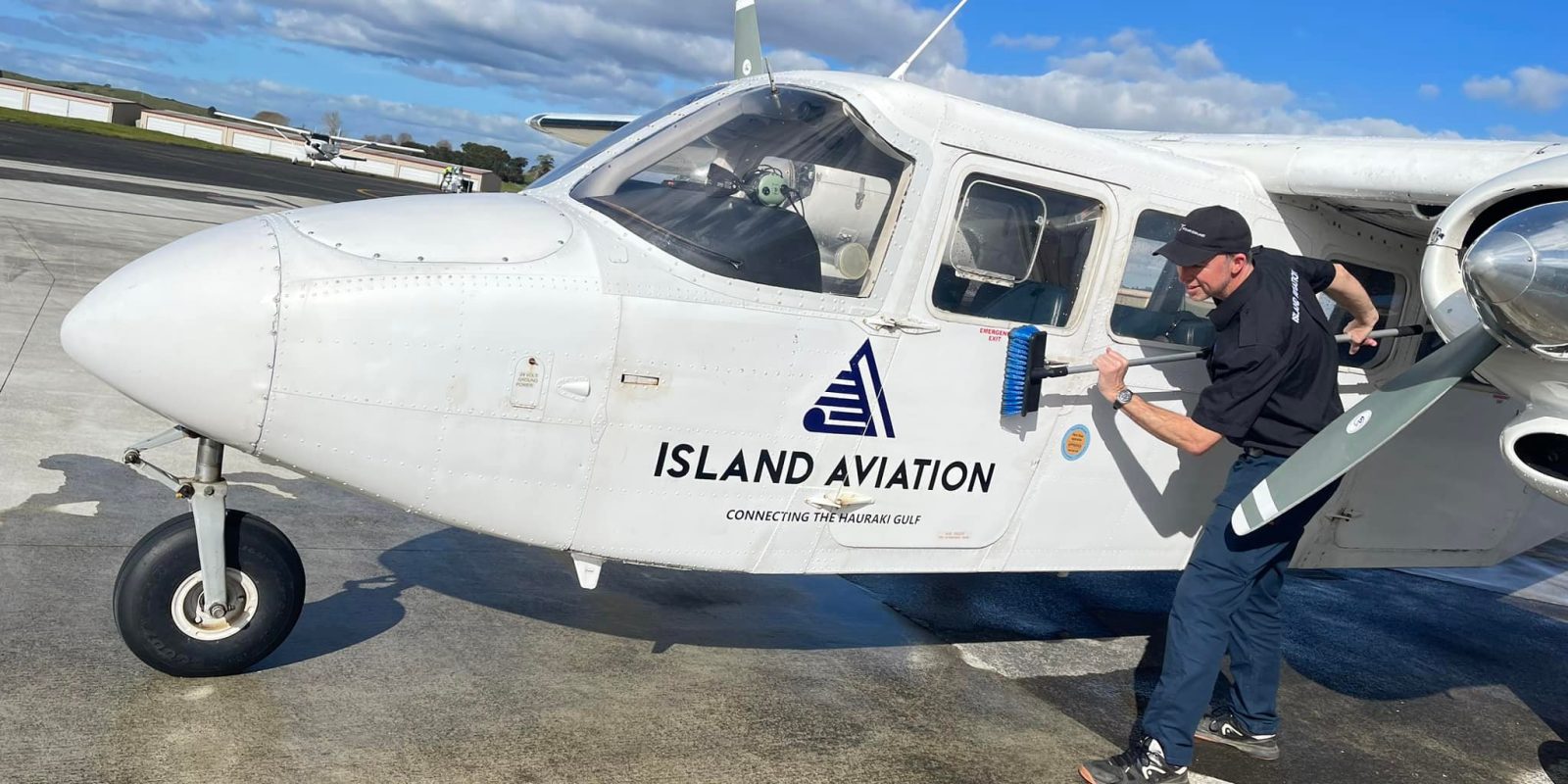

Great Barrier Island has a second airline again, and it exists largely because Island Aviation’s founder Chris Sattler stepped in after Fly My Sky collapsed during COVID, restoring competition on one of New Zealand’s most critical routes.
We meet Sattler at Island Aviation’s Ardmore engineering base. They don’t fly scheduled services from here yet, but Ardmore sits firmly in his future plans as the business looks to link the Hauraki Gulf more tightly.

That thinking underpins Island Aviation’s Barrier operation. Rather than funnelling everyone through Māngere, the airline flies primarily out of North Shore Aerodrome, cutting out Auckland Airport parking costs, queues, and long drives for people living north and central.
“When we did the study about where to locate ourselves, for about one third of Auckland’s population, North Shore is the more convenient departure point than Auckland Airport,” Sattler says.
The airline’s entry into the Barrier market came indirectly. Sattler says he never set out to run a Great Barrier service, but his wider aviation ambitions put him in the right place when Fly My Sky failed.

“I was in discussions about acquiring Fly My Sky pre-COVID,” he says. “When that didn’t happen and the business collapsed, we bought some of the aircraft and decided it made sense for us to operate them.”
Fly My Sky carried around 22,000 passengers in its final year. Its collapse left Barrier residents with a single carrier — a situation Island Aviation was willing to challenge, but not by racing to the bottom on price.
“We don’t cut, we don’t offer silly fares, but we offer fair fares. So we have a fare every day that you can book, $149, one way,” Sattler says. “We don’t charge over $200. Our highest fare is $199.”
That pricing structure is deliberate. Island Aviation does not match the occasional sub-$100 promotional fares, but it caps prices during peak periods such as long weekends and holidays, when people often need to travel urgently.
Flights are supported by concession options, including 10-trip passes priced at $1,490, used by both corporate and regular flyers. Bank transfers are accepted, avoiding credit card fees.
Island Aviation’s broader model is built around spreading demand across the Gulf rather than replicating Auckland-centric routes. The airline connects Waiheke, Great Barrier, Okiwi, the Coromandel and other smaller airfields — places larger aircraft cannot easily serve.
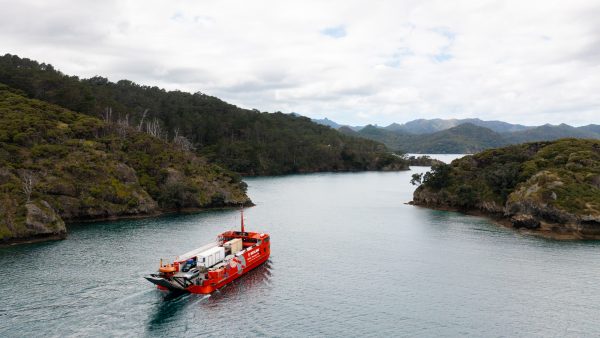
The timing matters. Sea access to Great Barrier is under strain, with the structural integrity of Tryphena Wharf now in a critical condition. SeaLink has warned of a “risk of collapse” should a vessel dock, increasing the importance of reliable air links.
Island Aviation also flies into Okiwi, supporting the island’s northern community. During the early 2023 flooding, when the road between Okiwi and Claris was cut, the airline was chartered to deliver essential supplies.
“We flew about 800 kilos of freight to Okiwi,” Sattler says. “Milk, flour, tinned food, nappies — because the roads were blocked for a couple of days.”
Sattler says community support has been a priority, even if he hasn’t always been vocal about it. Island Aviation was Australasia’s first Carbon Zero airline in 2017 and has funded native planting on Great Barrier through Medlands Ecovision.
“We bought all the plants for this year and committed to buying the same level or more next year,” he says. “They’re all sourced on the island.”
He admits communication with the island could have been better.
“We’ve communicated to some parts, but probably not well enough,” Sattler says.
That is now being addressed, with Island Aviation hiring Linda to work on Aotea at Claris Airport as a visible on-island presence and point of contact.
Sattler is also blunt about the airline’s online booking system.
“It’s not perhaps the easiest website,” Sattler says, acknowledging it takes more steps than Barrier Air’s simpler setup. “It’s something we want to tackle.”
Operationally, the business is stable and deliberately scaled. Island Aviation can add or remove flights without overextending, and draw revenue from across the Hauraki Gulf rather than relying solely on the Barrier route. Current Great Barrier capacity could be doubled if demand warrants it, with Ardmore remaining a possible future option as the wider Gulf network grows.
“We can continue forever at the current rate, to be honest,” Sattler says. “I have no fixed timeline.”
Rather than chasing volume or undercutting fares, Island Aviation’s approach is to run a service that makes sense long term — fair pricing, capped peaks, flexible aircraft, and multiple routes supporting each other. For Great Barrier, it means a second set of wings that isn’t here for a quick grab, but built to stay.