
Glenfern Sanctuary is moving ahead with a major upgrade to its volunteer accommodation, with five new cabins and a fully equipped communal hub set to support conservation work across the northern end of Aotea.
Sanctuary manager Steve Clemow said the new facilities will play a central role in expanding the organisation’s capacity. “We are building 5 individual cabins along with a communal facility,” he said.

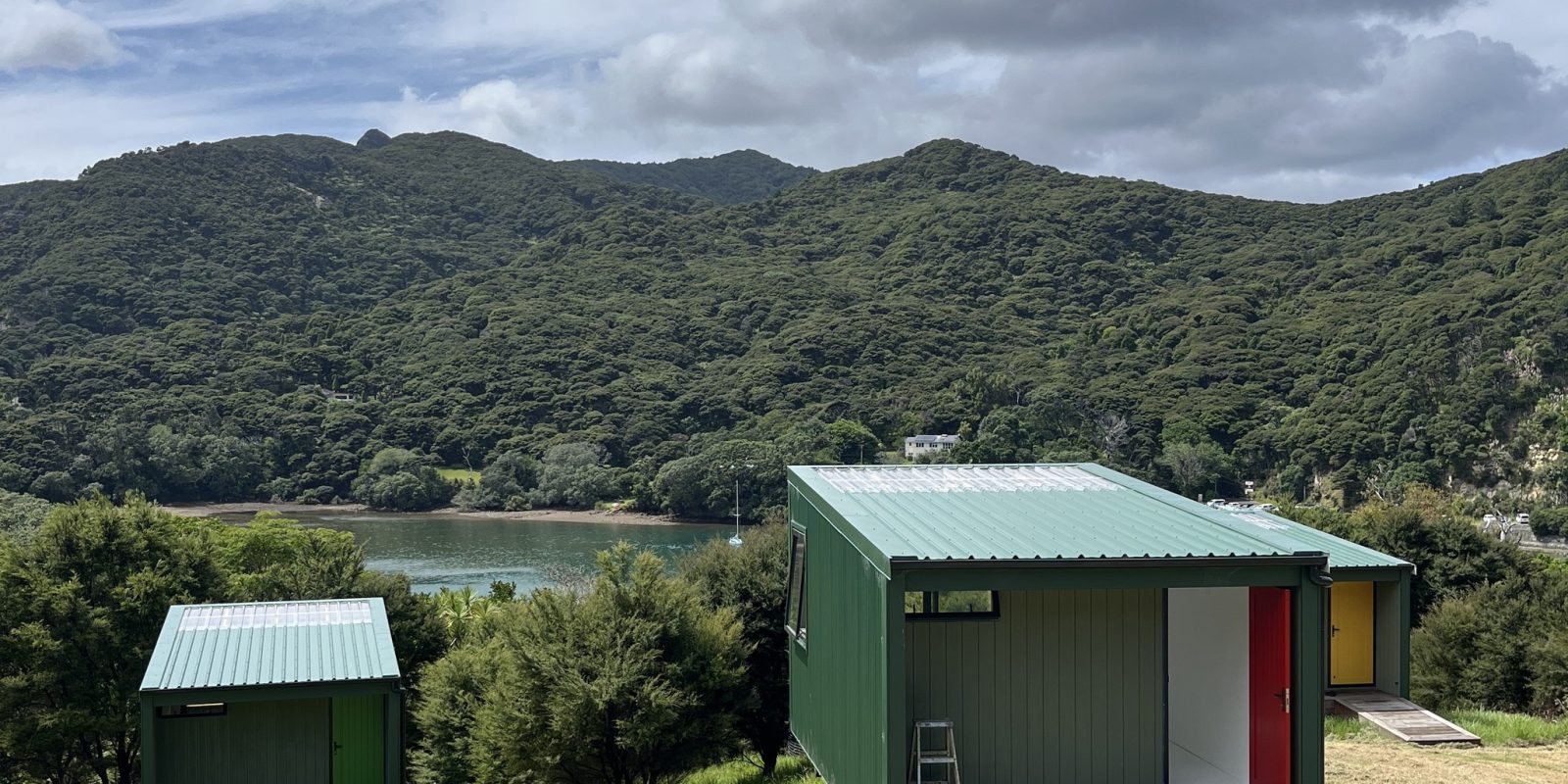
The communal building — now complete — includes toilets, showers, a kitchen, laundry and social space. Clemow said it is already proving useful, “hosting several ecology vision presentation evenings, being used as a study space by Te Pou Ramaroa and also a great place to present our work to visiting youth from Spirit of NZ and NZ Sailing Trust.”
Once the cabins open, the hub will serve as the central site for volunteers and visiting specialists to “cook, clean and socialise.” A wood-fired pizza oven, donated by Ngāti Rehua Ngātiwai ki Aotea Trust via the Community Led Development Programme, has also been installed in the outdoor area, adding to the shared space.
Low-impact design
The five cabins are designed as compact bedrooms with a small private deck attached. They will be available for short-term use by “volunteers, researchers, rangers, seabird specialists etc. basically anyone that performs a conservation role both within Glenfern and also hopefully across the rest of Aotea as well.”
Clemow said considerable effort has gone into making the new structures blend into the surrounding landscape. “The design of the cabins and communal building has been aimed at merging them as much as possible into the environment. They all face slightly different directions for privacy. The buildings have been kept small, recessive colours have been used and future planting will further add to this.”
Two cabins are close to completion, with the remaining three expected soon.

Bigger conservation gains expected
The additional accommodation is expected to have a direct impact on the sanctuary’s conservation output. Glenfern currently checks 1,500 traps monthly, and expanded volunteer capacity will allow that to increase, along with more revegetation work, enhanced biodiversity monitoring and improved pest plant control.
Clemow said interest from potential helpers is already building. “Even though we are yet to have cabins ready to occupy we have already received a large number of excellent applications to come and volunteer in the new year.”
Supporters acknowledged
Clemow also credited the wide range of organisations and community members who have contributed to the project. “Funding from Lotto (DIA), Foundation North, GBA’s (Good Buggers Association) and Aotea Local Board.”
He noted off-island support from businesses and individuals providing trade accounts, transport, architecture, engineering and geotech services. Kitchen and laundry cabinets were “manufactured, transported and installed by Novalab.”
On-island trades supporting the project include Great Barrier Building Company, LJM Plumbing, PGD Works, Barrier Drainage, GBI Surveys, Aotea Contractors and Waitiki Trading.
Volunteers have also been central. Clemow said the build has benefited from “heaps of volunteer hours from groups like the Sailing Trust, Spirit of NZ, the Friday yoga group who have painted the exterior plywood after yoga and also our Sanctuary management team who have project managed the build in their ‘spare’ time and are now completing the build.”
Glenfern’s roots: founders, mission and public purchase
Glenfern traces back to 1992, when sailing champion Tony Bouzaid and his wife Mal bought the property and began transforming it into a refuge for native wildlife. The Bouzaids restored the historic Fitzroy House, established pest-control and trapping networks, and built a walking track — known as the “Glenfern Loop” — offering access through native bush and a chance to see rare and endangered species.
The Sanctuary covers 83 hectares and, together with neighbouring land on the 240-hectare Kotuku Peninsula, is enclosed behind a 2 km predator-proof fence. That protection has allowed threatened species such as the endangered tāiko / black petrel, pāteke / brown teal, and the chevron skink (niho taniwha) to thrive.
After Bouzaid’s death in 2011, the property was put up for sale. A conservation-minded consortium led by the government, the Auckland Council, local authorities and philanthropic support secured the purchase in mid-2016. From then on, Glenfern has been managed as a regional park, with public access open daily from sunrise to sunset.